Culture Supernatant Injection for Joint Pain: A New Cell-Free Approach to Regenerative Medicine

Updated: Sep 14
Joint pain can slowly change the way a person lives. Taking the stairs becomes uncomfortable. Exercise becomes more difficult. A painful knee can make a simple walk feel longer than it should, while shoulder pain may interfere with sleep, work, or everyday movement.
For people living in Dubai, where active lifestyles, sports, fitness, and long working hours are part of daily life, joint health is becoming an increasingly important topic.
Traditional treatment options for joint pain may include physiotherapy, exercise, medication, corticosteroid injections, hyaluronic acid injections, and surgery when necessary. At the same time, growing interest in regenerative medicine has introduced another area of research: treatments that use the substances released by stem cells rather than injecting the stem cells themselves.
One of these approaches is known as culture supernatant injection.
It may also be described as stem cell conditioned medium therapy or, more broadly, as a treatment involving the stem cell secretome.
The idea is simple but scientifically interesting. Stem cells communicate with surrounding tissues by releasing a complex mixture of biological signals. Researchers are studying whether these signals can be collected and used in cell-free regenerative treatments.
So, what exactly is culture supernatant? How is it different from stem cell therapy or exosome therapy? And what does current science say about its potential role in osteoarthritis and joint pain?
Medically reviewed by Dr. Ehsan Sotoudeh, MD – General Surgeon & Regenerative Medicine Expert
Last medically reviewed: July 27, 2026

What Is Culture Supernatant?
To understand culture supernatant, it helps to understand how stem cells behave in a laboratory.
When mesenchymal stromal cells, commonly called MSCs, are grown under controlled laboratory conditions, they are placed in a liquid environment that provides the nutrients and conditions needed for cell growth.
While the cells are being cultured, they interact with their environment and release many different substances into the surrounding liquid.
After the cells are separated from this liquid, the remaining fluid is called culture supernatant or conditioned medium.
This liquid does not contain the living stem cells used to produce it when it has been appropriately processed as a cell-free product.
Instead, it may contain a complex mixture of biologically active substances released by the cells.
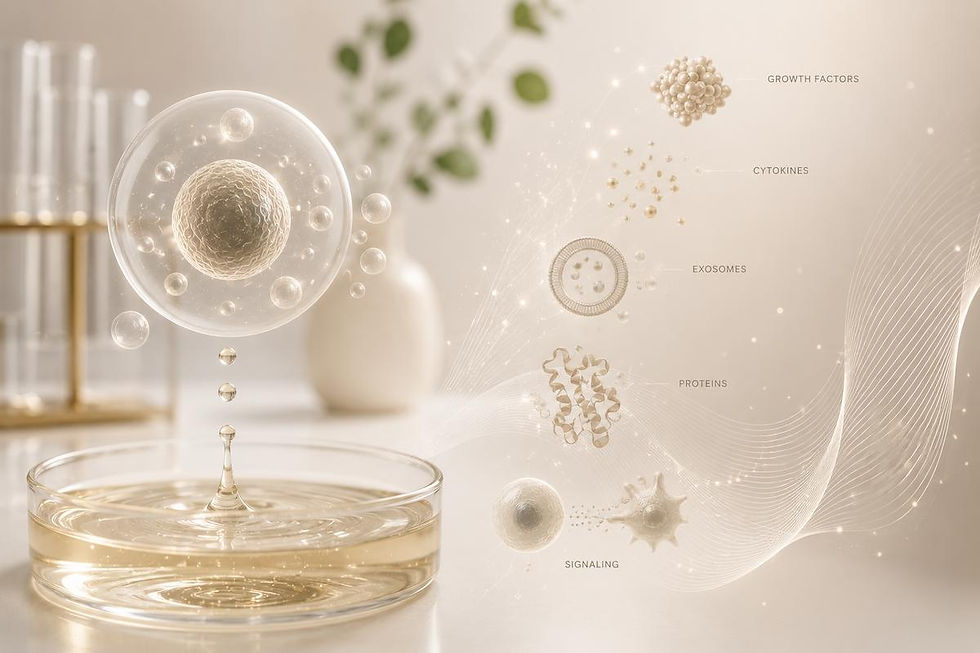
These may include growth factors, cytokines, chemokines, proteins, lipids, metabolites, and extracellular vesicles.
Among those extracellular vesicles may be exosomes, small particles involved in communication between cells.
This collection of substances released by cells is often referred to as the secretome.
For this reason, culture supernatant therapy is sometimes discussed under the broader concept of stem cell secretome therapy.
Why Are Scientists Interested in the Stem Cell Secretome?
For many years, researchers believed that the potential effects of mesenchymal stromal cells were mainly connected to their ability to develop into different types of tissue.
Scientific understanding has become more complex.
Researchers have found that much of the biological activity associated with MSCs may come from the signals they release.
These signals can interact with surrounding cells and may influence inflammation, immune responses, tissue repair, blood vessel formation, and other biological processes.
This is known as the paracrine effect.
Rather than physically replacing damaged tissue, stem cells may act partly by sending signals that affect how nearby cells behave.
This discovery has led researchers to ask an important question.
If some of the potential therapeutic effects of stem cells come from the substances they release, could those substances be used without administering living cells?
That question has helped drive interest in cell-free regenerative medicine.
Culture Supernatant Injection Is Not the Same as Stem Cell Therapy
One of the most important distinctions for patients is that culture supernatant injection is not the same treatment as a live stem cell injection.
Traditional stem cell based therapy involves administering living cells.
Culture supernatant treatment uses the cell free liquid collected from the environment in which cells have been grown.
The two approaches are connected scientifically, but they are different products.
Stem cell therapy introduces living cells into the body. These cells may interact with the local tissue environment and release biological signals over time.
Culture supernatant provides substances that have already been secreted by cells during the culture process.
Understanding this difference is important when researching regenerative medicine treatments because terms such as stem cells, exosomes, secretome, and conditioned medium are sometimes used too loosely.
Patients should always ask exactly what product is being discussed.
Is Culture Supernatant the Same as Exosome Therapy?
Not exactly.
This is another common source of confusion.
Exosomes are small extracellular vesicles released by cells. They can carry proteins, lipids, and genetic material between cells and are being widely studied for their role in cell communication.
Culture supernatant may contain exosomes, but it can also contain many other substances.
These may include soluble growth factors, cytokines, chemokines, proteins, metabolites, and other extracellular vesicles.
An exosome product usually refers to a preparation in which extracellular vesicles or exosomes have undergone some form of isolation, concentration, or purification.
Culture supernatant is a broader mixture of substances produced by cultured cells.
In simple terms, exosomes may be one component of the stem cell secretome, while conditioned medium can contain a much wider range of biological signals.
Why Is Culture Supernatant Being Studied for Joint Pain?
Joint conditions such as osteoarthritis are more complicated than simple wear and tear.
Osteoarthritis involves changes in cartilage, bone, synovial tissue, inflammation, and the overall biological environment of the joint.
Pain and stiffness may gradually increase as these changes progress.
Researchers are therefore interested in treatments that may influence inflammation and cellular communication inside the joint.
Laboratory and animal studies have suggested that mesenchymal stem cell conditioned medium may have anti inflammatory and immunomodulatory effects.
Researchers are also studying whether substances within the secretome may influence cartilage cells and other tissues involved in joint health.
However, these areas remain under investigation, and early biological findings should not be interpreted as proof that conditioned medium injections can regenerate damaged human cartilage or reverse osteoarthritis.

Which Joints Are Being Discussed in Relation to Culture Supernatant Injections?
Interest in local regenerative injections is often connected to joints that are commonly affected by osteoarthritis, sports injuries, repetitive movement, or age related changes.
These include the knee, shoulder, ankle, and elbow.
The knee receives particular attention because knee osteoarthritis is one of the most common causes of chronic joint pain and reduced mobility.
A person considering any joint injection should first receive an accurate diagnosis. Knee pain caused by early osteoarthritis may require a very different treatment plan from pain caused by a ligament injury, meniscus tear, fracture, infection, or advanced structural damage.
The same principle applies to other joints.
The treatment should follow the diagnosis, not the other way around.
Culture Supernatant Injection for Knee Osteoarthritis
Knee osteoarthritis is one of the main areas of interest in regenerative medicine.
As osteoarthritis progresses, patients may experience pain, stiffness, swelling, reduced mobility, and difficulty with activities such as walking, climbing stairs, or exercising.
Conventional treatment may include weight management, exercise, physiotherapy, medication, corticosteroid injections, hyaluronic acid injections, and surgery when clinically necessary.
Researchers are now studying whether cell free products derived from mesenchymal stromal cells could become another option within this treatment landscape.
The scientific interest is based largely on the biological substances present in the secretome and their potential influence on inflammation and tissue signaling.
Much of the research specifically involving conditioned medium for osteoarthritis is still preclinical. Studies in laboratory and animal models have reported encouraging effects on inflammation and markers of joint damage, but larger, well designed human clinical trials are needed before clear conclusions can be made about effectiveness, ideal dosing, product preparation, treatment frequency, and long term outcomes.
Could Culture Supernatant Reduce Joint Inflammation?
Inflammation plays an important role in many painful joint conditions.
Mesenchymal stromal cells release substances that can interact with immune cells and inflammatory pathways.
This has led researchers to study whether conditioned medium derived from these cells may help modify inflammatory activity.
Preclinical studies have reported anti inflammatory effects in experimental models of arthritis and osteoarthritis.
This is scientifically promising, but there is an important difference between demonstrating a biological effect in laboratory research and proving that a treatment consistently reduces pain and improves function in patients.
Clinical evidence is still developing.
Can Culture Supernatant Repair Cartilage?
This is one of the most important questions patients ask about regenerative medicine.
The answer requires caution.
Researchers are studying whether growth factors, extracellular vesicles, and other signaling molecules released by stem cells can influence cartilage cells and the environment within damaged joints.
Preclinical studies have reported effects related to cartilage protection, inflammation control, and tissue repair pathways.
However, there is currently not enough high quality clinical evidence to claim that culture supernatant injections reliably regrow human cartilage or reverse established osteoarthritis.
A responsible discussion of regenerative medicine should clearly separate scientific potential from proven clinical outcomes.
Could This Treatment Help Delay Joint Replacement Surgery?
Many people with osteoarthritis search for treatments that may help them remain active and postpone major surgery.
Whether surgery can be delayed depends on many factors, including the severity of joint damage, the cause of pain, age, activity level, overall health, response to conservative treatment, and the presence of structural problems.
Cell free regenerative injections are being studied as possible options for managing symptoms and influencing the joint environment.
However, there is not enough evidence to promise that culture supernatant injections will prevent or delay joint replacement surgery.
For some patients with advanced osteoarthritis or severe structural damage, surgery may remain the most appropriate treatment.
Book Your Joint Pain Consultation in Dubai
Culture Supernatant vs Stem Cell Therapy vs Exosome Therapy
Understanding the differences between these treatments can make regenerative medicine easier to navigate.
Treatment | What Is Administered? | Contains Living Cells? | Main Area of Scientific Interest |
Stem Cell Therapy | Mesenchymal stromal cells or another defined cell preparation | Yes | Cellular signaling, immune modulation, tissue repair, and regenerative potential |
Culture Supernatant or Conditioned Medium | Cell free liquid collected after cells have been cultured | No | The combined biological effects of the stem cell secretome |
Exosome Therapy | Isolated or enriched extracellular vesicle preparations | No | Cell communication and targeted biological signaling |
PRP | Concentrated platelets prepared from the patient's own blood | No stem cells | Growth factor release and support of the healing response |
Hyaluronic Acid Injection | Hyaluronic acid preparation | No | Joint lubrication and symptom management in selected patients |
Corticosteroid Injection | Anti inflammatory medication | No | Reduction of inflammation and pain in selected conditions |
These treatments are not interchangeable, and one option cannot automatically be considered better than another.
The most appropriate treatment depends on the diagnosis, available clinical evidence, patient characteristics, and local regulatory requirements.
What Are the Possible Advantages of Cell Free Regenerative Medicine?
Researchers are interested in cell free approaches for several reasons.
Because conditioned medium does not rely on administering living cells, it may offer practical advantages related to product storage, manufacturing, standardization, and administration.
Scientists can also study the components of the secretome to better understand which substances are responsible for particular biological effects.
Cell free treatments may eventually make it possible to develop more standardized regenerative products.
However, this remains a developing field.
The biological composition of conditioned medium can vary depending on the source of the cells, culture conditions, manufacturing process, purification methods, concentration, storage, and quality control.
For this reason, two products described as stem cell conditioned medium may not necessarily be biologically identical.
What Are the Limitations?
The main limitation is the lack of large scale human clinical evidence.
Many encouraging findings come from laboratory research and animal studies.
Important questions remain unanswered.
Researchers still need to establish which cell sources produce the most useful secretome, how products should be manufactured and standardized, what dose should be used, how frequently injections should be given, which patients are most likely to respond, and how long any clinical benefits may last.
The field also requires clear terminology.
Marketing a product as stem cell therapy when it does not contain living stem cells can create confusion. The same is true when all conditioned medium products are described simply as exosome therapy.
Patients deserve to know exactly what is being administered.
Who May Be Interested in Learning About Culture Supernatant Injections?
Patients searching for information about culture supernatant injections may include people with persistent joint pain, osteoarthritis, sports related joint problems, or symptoms that have not improved sufficiently with conservative care.
Others may simply be researching new developments in regenerative medicine before making treatment decisions.
Interest in a treatment does not mean that a person is medically suitable for it.
A proper consultation should include an accurate diagnosis, medical history, physical examination, review of imaging when appropriate, discussion of previous treatments, and an explanation of established and emerging treatment options.
Why Is This Topic Relevant in Dubai?
Dubai has become an important regional destination for healthcare, wellness, longevity medicine, orthopedics, sports medicine, and regenerative medicine.
The city's active population includes professional athletes, recreational sports enthusiasts, residents managing chronic joint conditions, and international patients interested in new medical technologies.
As patient interest in regenerative medicine grows, so does the need for accurate information.
People searching for culture supernatant injection in Dubai, stem cell secretome therapy, exosome treatment for joint pain, or regenerative medicine for osteoarthritis should be able to understand the differences between these treatments and the current level of scientific evidence.
Newer does not automatically mean better.
The most valuable medical innovation is innovation supported by careful research, transparent patient education, appropriate regulation, and responsible clinical use.
Frequently Asked Questions
What is a culture supernatant injection?
Culture supernatant is the liquid collected from the environment in which cells have been grown. After the cells are removed, the liquid may contain growth factors, cytokines, proteins, metabolites, extracellular vesicles, and other signaling molecules released by the cells.
Is culture supernatant a stem cell treatment?
It is derived from stem cell culture processes but is not the same as injecting living stem cells. Properly processed culture supernatant is a cell free product.
What is stem cell conditioned medium?
Stem cell conditioned medium is another term used for culture medium that has been exposed to cultured stem cells and contains substances released by those cells.
What is the stem cell secretome?
The secretome refers to the broad collection of substances released by cells, including soluble proteins, cytokines, growth factors, extracellular vesicles, and other biological molecules.
Does culture supernatant contain exosomes?
It may contain extracellular vesicles, including exosomes, depending on the production and processing methods. This does not make culture supernatant identical to an isolated or purified exosome product.
Can culture supernatant injections treat knee osteoarthritis?
Conditioned medium derived from mesenchymal stromal cells is being studied for osteoarthritis, but much of the evidence remains preclinical. More high quality human studies are needed to establish effectiveness and long term safety.
Can culture supernatant injections regrow cartilage?
There is currently insufficient clinical evidence to claim that culture supernatant injections reliably regrow human cartilage or reverse established osteoarthritis.
Are culture supernatant injections used for shoulder or ankle pain?
Local injections have been discussed and studied in relation to different musculoskeletal conditions. Whether any injection is appropriate depends on the cause of the pain, medical assessment, available evidence, and local regulations.
Is conditioned medium better than PRP?
There is not enough high quality evidence to say that conditioned medium is generally better than PRP. The products have different biological compositions, evidence bases, and clinical applications.
Is culture supernatant the same as hyaluronic acid?
No. Hyaluronic acid is used in selected patients to support joint lubrication and symptom management. Culture supernatant contains substances released by cultured cells and is being studied for its biological signaling effects.
Can this treatment help avoid surgery?
There is currently insufficient evidence to guarantee that culture supernatant injections can prevent or delay surgery. The need for surgery depends on the diagnosis, severity of joint damage, symptoms, and response to appropriate treatment.
Is culture supernatant injection available in Dubai?
The availability and permitted clinical use of regenerative medicine products depend on the specific product, medical indication, healthcare facility, physician authorization, and current UAE regulatory requirements. Patients should verify these details directly with licensed healthcare professionals and relevant authorities.
The Future of Cell Free Regenerative Medicine
For years, much of regenerative medicine focused on the stem cell itself.
Today, scientists are paying increasing attention to the messages cells send.
Growth factors, cytokines, proteins, extracellular vesicles, and other signaling molecules may help explain how stem cells communicate with damaged tissues and influence inflammation and repair processes.
Culture supernatant sits at the center of this growing field.
It offers a different way of thinking about regenerative medicine: using biological signals produced by cells rather than necessarily administering the cells themselves.
The science is promising, but it is still developing.
More clinical trials are needed to determine which patients may benefit, how these products should be manufactured and standardized, what doses should be used, and whether improvements in pain or function can be maintained over time.
For people in Dubai exploring new approaches to joint pain, osteoarthritis, and regenerative medicine, understanding the science is the best place to start.
The future of joint care may not depend on one treatment alone. It may come from better diagnosis, earlier intervention, rehabilitation, healthy lifestyle choices, established medical treatments, and carefully studied regenerative technologies used together in the right patients.
As research continues, culture supernatant and stem cell secretome therapy are likely to remain important areas to watch in the rapidly developing field of cell free regenerative medicine.
Speak With Our Regenerative Medicine Team


Comments